Construction Industry
Jobs, Salary and Education Information
Significant Points
- Job opportunities are expected to be good, especially for skilled and experienced construction trades workers.
- Workers have relatively high hourly earnings.
- About 68 percent of establishments employ fewer than 5 people.
- Construction includes a very large number of self-employed workers.
Top 3 Construction Jobs
-
Safety Coordinator - Columbus, OH - 5125
- PROGRESSIVE ROOFING
- Columbus,OH
Safety Coordinator - Columbus, OH - 5125 We take safety seriously. Do you?We take pride in our certified, trained status as providers for every major roofing manufacturer, ensuring single-source responsibility. Specializing...
-
Superintendent
- Ferguson Construction
- Columbus,OH
Ferguson Construction is a leading general contracting and construction management firm with over 100 years of industry expertise. We handle a diverse range of projects, including industrial, commercial, healthcare, and institutional buildings.
-
Multi-Store Supervisor - #700
- Sheetz
- Groveport,OH
Additional Job Info: Additional $1.50/hr. for working 10pm-6am Overview: Love meeting new people and shaking things up? Time to flex your hustle as a Multi-Store Supervisor! You'll be the secret sauce behind...
Get the training you need: Find schools for Construction near you!
Nature of the Construction Industry[About this section] [To Top]
Goods and services. Houses, apartments, factories, offices, schools, roads, and bridges are only some of the products of the construction industry. This industry's activities include the building of new structures, including site preparation, as well as additions and modifications to existing ones. The industry also includes maintenance, repair, and improvements on these structures.
Industry organization. The construction industry is divided into three major segments. The construction of buildings segment includes contractors, usually called general contractors, who build residential, industrial, commercial, and other buildings. Heavy and civil engineering construction contractors build sewers, roads, highways, bridges, tunnels, and other projects related to our Nation's infrastructure. Specialty trade contractors perform specialized activities related to all types of construction such as carpentry, painting, plumbing, and electrical work.
Construction usually is done or coordinated by general contractors, who specialize in one type of construction such as residential or commercial building. They take full responsibility for the complete job, except for specified portions of the work that may be omitted from the general contract. Although general contractors may do a portion of the work with their own crews, they often subcontract most of the work to heavy construction or specialty trade contractors.
Specialty trade contractors usually do the work of only one trade, such as painting, carpentry, or electrical work, or of two or more closely related trades, such as plumbing and heating. Beyond fitting their work to that of the other trades, specialty trade contractors have no responsibility for the structure as a whole. They obtain orders for their work from general contractors, architects, or property owners. Repair work is almost always done on direct order from owners, occupants, architects, or rental agents.
Recent developments. The construction industry has been strongly affected by the credit crisis and recession that began in December 2007. Housing prices fell and foreclosures of homes rose sharply, particularly in overbuilt areas of the country. New housing construction, while still ongoing, dropped significantly. The recession is expected to impact other types of construction as well. Retailers are refraining from building new stores and State and local governments are reducing spending. However, as energy costs have risen, some companies are finding it necessary to build or renovate buildings that are not energy efficient. "Green construction" is an area that is increasingly popular and involves making buildings as environmentally friendly and energy efficient as possible by using more recyclable and earth-friendly products.
Work Environment for the Construction Industry[About this section] [To Top]
Hours. Most employees in the construction industry work full time, and many work over 40 hours a week. In 2008, about 18 percent of construction workers worked 45 hours or more a week. Construction workers may sometimes work evenings, weekends, and holidays to finish a job or take care of an emergency. Rain, snow, or wind may halt construction work. Workers in this industry usually do not get paid if they can't work due to inclement weather.
Work environment. Workers in this industry need physical stamina because the work frequently requires prolonged standing, bending, stooping, and working in cramped quarters. They also may be required to lift and carry heavy objects. Exposure to the weather is common because much of the work is done outside or in partially enclosed structures. Construction workers often work with potentially dangerous tools and equipment amidst a clutter of building materials; some work on temporary scaffolding or at great heights. Consequently, they are more prone to injuries than workers in other jobs. Data from the U.S. Bureau of Labor Statistics show that many construction trades workers experienced a work-related injury and illness rate that was higher than the national average. In response, employers increasingly emphasize safe working conditions and habits that reduce the risk of injuries. To avoid injury, employees wear safety clothing, such as gloves, hardhats, and devices to protect their eyes, mouth, or hearing, as needed.
Employment in the Construction Industry[About this section] [To Top]
Construction, with 7.2 million wage and salary jobs and 1.8 million self-employed and unpaid family workers in 2008, was one of the Nation's largest industries. About 64 percent of wage and salary jobs in construction were in the specialty trade contractors sector, primarily plumbing, heating, and air-conditioning; electrical; and masonry. Around 23 percent of jobs were in residential and nonresidential building construction. The rest were in heavy and civil engineering construction (table 1).
| Industry | Employment | Percent |
|---|---|---|
| Construction, total | 7,214.9 | 100.0 |
| Construction of buildings | 1,659.3 | 23.0 |
| Residential building | 832.1 | 11.5 |
| Nonresidential building construction | 827.2 | 11.5 |
| Heavy and civil engineering construction | 970.3 | 13.4 |
| Utility system construction | 451.3 | 6.3 |
| Highway, street, and bridge construction | 328.9 | 4.6 |
| Land subdivision | 80.8 | 1.1 |
| Other heavy and civil engineering construction | 109.3 | 1.5 |
| Specialty trade contractors | 4,585.3 | 63.6 |
| Building equipment contractors | 2,023.1 | 28.0 |
| Foundation, structure, and building exterior contractors | 987.8 | 13.7 |
| Building finishing contractors | 912.8 | 912.8 |
| Other specialty trade contractors | 661.6 | 9.2 |
Employment in this industry is distributed geographically in much the same way as the Nation's population. There were about 884,300 construction establishments in the United States in 2008: 269,700 were building construction contractors; 57,600 were heavy and civil engineering construction or highway contractors; and 557,000 were specialty trade contractors. Most of these establishments tend to be small; 68 percent employed fewer than 5 workers. About 12 percent of workers are employed by these very small contractors.
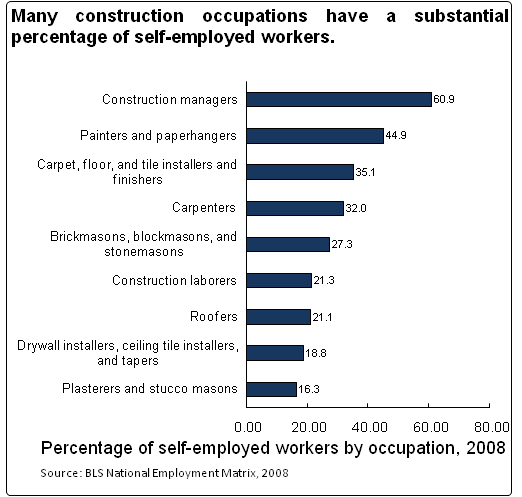
Construction offers more opportunities than most other industries for individuals who want to own and run their own business. The 1.8 million self-employed and unpaid family workers in 2008 performed work directly for property owners or acted as contractors on small jobs, such as additions, remodeling, and maintenance projects. The rate of self-employment varies greatly by individual occupation in the construction trades, partially dependent on the cost of equipment or structure of the work (chart).
Occupations in the Construction Industry[About this section] [To Top]
Construction offers a great variety of career opportunities. People with many different talents and educational backgrounds—managers, clerical workers, accountants, engineers, truck drivers, trades workers, and construction helpers—find job opportunities in the construction industry (table 3).
Construction trades occupations. Most of the workers in construction are construction trades workers, which include master, journey, and apprentice craft workers, and construction laborers. Most construction trades workers are classified as either structural, finishing, or mechanical workers, with some performing activities of more than one type. Structural workers build the main internal and external framework of a structure and can include carpenters; construction equipment operators; brickmasons, blockmasons, and stonemasons; cement masons and concrete finishers; and structural and reinforcing iron and metal workers. Finishing workers perform the tasks that give a structure its final appearance and may include carpenters; drywall installers; ceiling tile installers; plasterers and stucco masons; segmental pavers; terrazzo workers; painters and paperhangers; glaziers; roofers; carpet, floor, and tile installers and finishers; and insulation workers. Mechanical workers install the equipment and material for basic building operations and may include pipelayers, plumbers, pipefitters, and steamfitters; electricians; sheet metal workers; and heating, air-conditioning, and refrigeration mechanics and installers.
Construction trades workers are employed in a large variety of occupations that are involved in all aspects of the construction industry. Boilermakers make, install, and repair boilers, vats, and other large vessels that hold liquids and gases. Brickmasons, blockmasons, and stonemasons build and repair walls, floors, partitions, fireplaces, chimneys, and other structures with brick, pre-cast masonry panels, concrete block, stone, and other masonry materials. Carpenters construct, erect, install, or repair structures and fixtures made of wood, such as framing walls and partitions, putting in doors and windows, building stairs, laying hardwood floors, and hanging kitchen cabinets. Carpet, floor, and tile installers and finishers lay floor coverings, apply tile and marble, and sand and finish wood floors in a variety of buildings. Cement masons, concrete finishers, segmental pavers, and terrazzo workers smooth and finish poured concrete surfaces and work with concrete to create sidewalks, curbs, roadways, or other surfaces. Construction equipment operators, also known as operating engineers, use machinery that moves construction materials, earth, and other heavy materials and applies asphalt and concrete to roads and other structures. Drywall installers, ceiling installers, and tapers fasten drywall panels to the inside framework of residential houses and other buildings and prepare these panels for painting by taping and finishing joints and imperfections. Electricians install, connect, test, and maintain building electrical systems, which also can include lighting, climate control, security, and communications. Glaziers are responsible for selecting, cutting, installing, replacing, and removing all types of glass. Insulation workers line and cover structures with insulating materials. Painters and paperhangers stain, varnish, and apply other finishes to buildings and other structures and apply decorative coverings to walls and ceilings. Pipelayers, plumbers, pipefitters, and steamfitters install, maintain, and repair many different types of pipe systems. They may also install heating and cooling equipment and mechanical control systems. Plasterers and stucco masons apply plaster, concrete, stucco, and similar materials to interior and exterior walls and ceilings. Roofers repair and install roofs made of tar or asphalt and gravel; rubber or thermoplastic; metal; or shingles made of asphalt, slate, fiberglass, wood, tile, or other material. Sheet metal workers fabricate, assemble, install, and repair products and equipment made out of sheet metal, such as duct systems; roofs; siding; and drainpipes. Structural and reinforcing iron and metal workers place and install iron or steel girders, columns, and other structural members to form completed structures or frameworks of buildings, bridges, and other structures. Lastly, construction laborers perform a wide range of physically demanding tasks at building and highway construction sites, such as tunnel and shaft excavation, hazardous waste removal, environmental remediation, and demolition. Many construction trades workers perform their services with the assistance of helpers. These workers assist trades workers and perform duties requiring less skill.
The construction industry employs nearly all of the workers in some construction craft occupations. Other industries that include large numbers of construction craft occupations are transportation equipment manufacturing; transportation, communication, and utilities; real estate; wholesale and retail trade; educational services; and State and local government (table 2).
| Occupation | Percent |
|---|---|
| Insulation workers | 91.7 |
| Cement masons, concrete finishers, and terrazzo workers | 89.4 |
| Structural iron and steel workers | 84.6 |
| Drywall installers, ceiling tile installers, and tapers | 80.2 |
| Plasterers and stucco masons | 79.9 |
| Roofers | 76.2 |
| Pipelayers, plumbers, pipefitters, and steamfitters | 71.6 |
| Electricians | 69.7 |
| Brickmasons, blockmasons, and stonemasons | 69.0 |
| Glaziers | 67.5 |
| Carpenters | 56.1 |
| Carpet, floor, and tile installers and finishers | 49.5 |
| Painters and paperhangers | 43.9 |
Mechanical and installation occupations. The construction industry employs a number of other workers apart from the construction trades. Elevator installers and repairers assemble, install, and replace elevators, escalators, moving walkways, and similar equipment in new and old buildings. Heating, air-conditioning, and refrigeration mechanics and installers install systems that control the temperature, humidity, and the total air quality in residential, commercial, industrial, and other buildings. Material moving occupations use machinery to move construction materials, earth, and other heavy materials, and clean vehicles, machinery, and other equipment.
Managerial occupations. First-line supervisors and managers of construction trades and extraction workers oversee trades workers and helpers and ensure that work is done well, safely, and according to code. They plan the job and solve problems as they arise. Those with good organizational skills and exceptional supervisory ability may advance to construction management occupations, including project manager, field manager, or superintendent. These workers are responsible for getting a project completed on schedule by working with the architect's plans, making sure materials are delivered on time, assigning work, overseeing craft supervisors, and ensuring that every phase of the project is completed properly and expeditiously. They also resolve problems and make sure that work proceeds without interruptions.
| Occupation | Employment, 2008 | Percent Change, 2008-18 |
|
|---|---|---|---|
| Number | Percent | ||
| All occupations | 7,214.9 | 100.0 | 18.5 |
| Management, business, and financial occupations | 571.4 | 7.9 | 21.6 |
| General and operations managers | 121.2 | 1.7 | 7.8 |
| Construction managers | 176.9 | 2.5 | 26.1 |
| Cost estimators | 128.0 | 1.8 | 32.6 |
| Office and administrative support occupations | 699.6 | 9.7 | 15.8 |
| Bookkeeping, accounting, and auditing clerks | 141.0 | 2.0 | 19.4 |
| Executive secretaries and administrative assistants | 75.9 | 1.1 | 17.5 |
| Secretaries, except legal, medical, and executive | 151.9 | 2.1 | 8.2 |
| Office clerks, general | 159.2 | 2.2 | 19.7 |
| Construction and extraction occupations | 4,741.7 | 65.7 | 18.0 |
| First-line supervisors/managers of construction trades and extraction workers | 442.1 | 6.1 | 22.7 |
| Brickmasons, blockmasons, and stonemasons | 110.5 | 1.5 | 14.3 |
| Carpenters | 721.0 | 10.0 | 15.2 |
| Carpet, floor, and tile installers and finishers | 79.4 | 1.1 | 13.3 |
| Cement masons, concrete finishers, and terrazzo workers | 184.7 | 2.6 | 13.9 |
| Construction laborers | 771.0 | 10.7 | 26.0 |
| Construction equipment operators | 297.5 | 4.1 | 18.1 |
| Drywall installers, ceiling tile installers, and tapers | 151.3 | 2.1 | 15.5 |
| Electricians | 484.0 | 6.7 | 15.3 |
| Painters and paperhangers | 197.6 | 2.7 | 8.2 |
| Pipelayers, plumbers, pipefitters, and steamfitters | 398.0 | 5.5 | 21.6 |
| Roofers | 113.5 | 1.6 | 6.5 |
| Sheet metal workers | 107.9 | 1.5 | 10.1 |
| Helpers, construction trades | 349.2 | 4.8 | 21.0 |
| Installation, maintenance, and repair occupations | 545.8 | 7.6 | 28.6 |
| Heating, air conditioning, and refrigeration mechanics and installers | 178.6 | 2.5 | 42.8 |
| Line installers and repairers | 83.5 | 1.2 | 21.4 |
| Transportation and material moving occupations | 251.8 | 3.5 | 12.6 |
| Truck drivers, heavy and tractor-trailer | 104.0 | 1.4 | 15.6 |
| NOTE: Columns may not add to total due to omission of occupations with small employment. | |||
Training and Advancement in the Construction Industry[About this section] [To Top]
Construction trades, mechanical, and installation and repair occupations. Construction trades workers and mechanical and installation occupations, such as carpenters, bricklayers, plumbers, heating, air-conditioning, and refrigeration mechanics and installers, and other construction trade specialists most often get their formal instruction by attending a local technical or trade school, participating in an apprenticeship, or taking part in an employer-provided training program. In addition, they learn their craft by working with more experienced workers. Most construction trades workers' jobs require proficiency in reading and mathematics. Safety training is also required for most jobs; English language skills are essential for workers to advance within their trade.
Apprenticeships are administered by local employers, trade associations, and trade unions and provide the most thorough training. Apprenticeships usually last between 3 and 5 years and consist of on-the-job training and 144 hours or more of related classroom instruction each year. In lieu of the hours of training, some apprenticeship programs now use competency standards, which make it possible to complete a program in a shorter time. Those who enroll in apprenticeship programs usually are at least 18 years old and in good physical condition. Many employers or programs require applicants to pass background checks.
Depending on the occupation, there may be technical or vocational schools that train students to perform a given occupation's tasks. Those who enter construction from technical or vocational schools also may complete apprenticeship training; technical or vocational school graduates progress at a somewhat faster pace because they already have had courses such as mathematics, mechanical drawing, and woodworking.
A few occupations have licensing requirements. Crane operators, electricians, plumbers, and heating and air- conditioning mechanics and installers are required to have a license in most States; without a license, a contractor cannot operate in the State. There are often separate licenses for contractors and workers. Other occupations do not have strict licensing requirements but often have voluntary certifications. These certifications provide tangible evidence of knowledge and abilities to potential employers and consumers. Certification is administered by many associations that are related to specific trades, but also are offered by other organizations as well. Licensing and certification requirements include years of work experience and classroom instruction. Licenses and certifications need to be renewed on a regular basis.
To further develop their skills, construction trades workers can work on different projects, such as housing developments, office and industrial buildings, or road construction. Flexibility and a willingness to adopt new techniques, as well as the ability to get along with people, are essential for advancement. Those who are skilled in all facets of the trade and who show good leadership qualities may be promoted to supervisor or construction manager. Construction managers may advance to superintendent of larger projects or go into the business side of construction. Some go into business for themselves as contractors. Those who plan to rise to supervisory positions should have basic Spanish language skills to communicate safety and work instructions to Spanish-speaking construction workers.
Outside the construction industry, construction trades workers may transfer to jobs such as construction building inspector, purchasing agent, sales representative for building supply companies, or technical or vocational school instructor. To advance to a management position, additional education and training are recommended.
Laborers and helpers advance in the construction trades occupations by acquiring experience and skill in various phases of the craft. As they demonstrate ability to perform tasks they are assigned, they move to progressively more challenging work. As their skills broaden, they are allowed to work more independently, and responsibilities and earnings increase. They may qualify for jobs in related, more highly skilled occupations. For example, after several years of experience, painters' helpers may become skilled painters.
Managerial occupations. Managerial personnel usually have a college degree or considerable experience in their specialty. Individuals who enter construction with college degrees usually start as management trainees or as assistants to construction managers. Those who receive degrees in construction science often start as field engineers, schedulers, or cost estimators. College graduates may advance to positions such as assistant manager, construction manager, general superintendent, cost estimator, construction building inspector, general manager or top executive, contractor, or consultant. Although a college education is not always required, administrative jobs usually are filled by those with degrees in business administration, finance, accounting, or similar fields.
Opportunities for workers to form their own firms are better in construction than in many other industries. Construction workers may need only a moderate financial investment to become contractors and they can run their businesses from their homes, hiring additional construction workers only as needed for specific projects. The contract construction field, however, is very competitive, and the rate of business turnover is high. Taking courses in business helps to improve the likelihood of success.
Job Outlook for the Construction Industry[About this section] [To Top]
Population growth, deteriorating infrastructure, and aging buildings will generate employment growth in the construction industry. Job opportunities are expected to be good for those construction workers with the most experience and skill.
Employment change. The number of wage and salary jobs in the construction industry is expected to grow 19 percent through the year 2018, compared with the 11 percent projected for all industries combined. Employment in this industry depends primarily on the level of new construction as well as renovation activity on older buildings, which is expected to increase modestly over the coming decade.
Residential construction is expected to grow moderately over the decade to meet the needs of a growing population. Particularly, as the oldest children of the baby boomers reach their peak house-buying years in the coming decade, demand for housing by them is expected to grow to meet their needs. Demand by an expanding older population for senior housing and healthcare residences will lead to growth in these areas. The renovation and expansion of older homes should prove relatively constant over the projection period.
Employment is expected to grow in the nonresidential construction sector over the decade as well. Replacement of many industrial plants has been delayed for years, and a large number of structures will have to be replaced or remodeled. There will also be a need for all types of medical treatment facilities to meet the demands of the growing elderly population. Construction of schools will continue to be needed, especially in the South and West, where the population is growing the fastest. However, the stress on many State and local governments’ budgets may be such that new construction for schools will be postponed for several years until the economy recovers.
Employment in heavy and civil engineering construction is projected to increase due to growth in new highway, bridge, and street construction, as well as in maintenance and repairs to prevent further deterioration of the Nation's existing highways and bridges. Voters and legislators in most States and localities continue to approve spending on road construction, which will create jobs over the next decade. Another area of expected growth is in power line and related construction. Even with increased conservation and more efficient appliances, there is an increasing demand for power. Increase demand for workers will likely result from new power plant construction and connecting these new facilities to the current power grids.
The largest number of new jobs is expected to be created in specialty trades contracting because it is the largest segment of the industry and because it is expected to grow about as fast as the rest of the construction industry. The number of jobs will grow as demand increases for subcontractors in new building and heavy construction, and as more workers are needed to repair and remodel existing homes, which specialty trade contractors are more likely to perform. Home improvement and repair construction is expected to continue even as new home construction slows. Remodeling should provide many new jobs because of a growing stock of old residential and nonresidential buildings. Many older, smaller homes will be remodeled to appeal to more affluent buyers interested in more space and amenities. Remodeling tends to be more labor-intensive than new construction. In addition, the construction industry, as well as all types of businesses and institutions, is increasingly contracting out the services of specialty trades workers instead of keeping these workers on their own payrolls.
Despite 19 percent overall employment growth of the construction industry, construction trades growth is expected to vary. For example, employment of rail-track laying and maintenance equipment operators; first line supervisors of construction trades; and pipelayers, plumbers, pipefitters, and steamfitters is projected to grow faster than the industry average because their specialized services will be in greater demand. On the other hand, employment of structural iron and steel workers is expected to grow more slowly than the construction industry as a whole as workers become more productive. Nonetheless, nearly all construction trades are projected to experience some growth. Only helpers of roofers and of painters, paperhangers, plasterers and stucco masons are expected to experience a decline.
Employment of construction managers is expected to grow as a result of the increasing complexity of construction work that needs to be managed, including the need to deal with the proliferation of laws dealing with building construction, worker safety, and environmental issues.
Job prospects. Job opportunities are expected to be good, especially for experienced and skilled construction trades workers, because of the need to replace the large number of workers anticipated to leave these occupations over the next decade.
Experienced construction workers, and new entrants with a good work history or prior military service, should enjoy the best job prospects. A variety of factors can affect job prospects and competition for positions. Entering specialties requiring specific education, certification, or licensure are likely to improve job prospects for those willing to get the needed certifications, licenses, training, and education. Jobs that cause a worker to be at great heights, are physically demanding, or expose workers to extreme conditions are also more likely to have less competition for positions and often have high replacement needs. Occupations that have few training needs are likely to have increased competition and less favorable job prospects.
Certain occupations should have particularly good job opportunities. Because of the difficulty in obtaining certification as a crane operator, some employers have been unable to fill some positions. Electricians, plumbers, pipefitters, and steamfitters are also licensed occupations that should have a favorable outlook due to projected job growth. Roofers should have favorable opportunities due to job growth and difficult working conditions, which lead to high replacement needs. Boilermakers; brickmasons, blockmasons, and stonemasons; and structural and reinforcing iron and rebar workers should have excellent opportunities because of the skills required to perform their duties and the difficult working conditions. Installation and maintenance occupations—including line installers and heating and air-conditioning mechanics and installers—also should have especially favorable prospects because of a growing stock of homes that will require service to maintain interior systems. Construction managers who have a bachelor's degree in construction science, with an emphasis on construction management, and related work experience in construction management services firms, should have especially good prospects as well. Employment growth among administrative support occupations will continue to be limited by office automation. Construction laborers needing less training should face competition for work due to few barriers to entrance to this occupation. The outlook for carpenters will be heavily dependent upon residential construction activity, which is unlikely to grow as fast as in recent years. Painters should have good opportunities because of demand for their work, while paperhangers should have less favorable opportunities because of the reduced demand for their work.
The number of job openings in construction may fluctuate from year to year. New construction is usually cut back during periods when the economy is not expanding or interest rates are high.
Construction Industry Salaries[About this section] [More salary/earnings info] [To Top]
Industry earnings. Earnings in construction are higher than the average for all industries (table 4). In 2008, production or nonsupervisory workers in construction averaged $21.87 an hour, or about $842 a week. In general, the construction trades workers needing more education and training, such as electricians and plumbers, get paid more than construction trades workers requiring less education and training, including laborers and helpers.
| Industry | Hourly | Weekly |
|---|---|---|
| Total, private industry | $18.08 | $608 |
| Construction | 21.87 | 842 |
| Construction of buildings | 21.39 | 813 |
| Nonresidential building | 23.10 | 914 |
| Residential building | 19.47 | 707 |
| Heavy and civil engineering construction | 22.00 | 924 |
| Utility system construction | 22.31 | 941 |
| Highway, street, and bridge construction | 22.11 | 731 |
| Other heavy construction | 21.78 | 947 |
| Land subdivision | 18.73 | 702 |
| Specialty trade contractors | 21.99 | 835 |
| Building equipment contractors | 23.56 | 918 |
| Building finishing contractors | 20.87 | 783 |
| Other specialty trade contractors | 20.86 | 795 |
| Building foundation and exterior contractors | 20.54 | 747 |
Earnings also vary by the worker's education and experience, type of work, complexity of the construction project, and geographic location. Wages of construction workers often are affected when poor weather prevents them from working. Traditionally, winter is the slack period for construction activity, especially in colder parts of the country, but there is a trend toward more year-round construction, even in colder areas. Construction trades are dependent on one another to complete specific parts of a project—especially on large projects—so work delays affecting one trade can delay or stop the work of another trade. Wages of selected occupations in construction appear in table 5.
| Occupation | Construction of buildings | Heavy and civil engineering construction | Specialty trade contractors | All industries |
|---|---|---|---|---|
| Construction managers | $37.45 | $39.87 | $38.34 | $38.39 |
| First-line supervisors/managers of construction trades and extraction workers | 28.49 | 28.10 | 27.49 | 27.95 |
| Plumbers, pipefitters, and steamfitters | 22.83 | 21.27 | 21.78 | 21.94 |
| Electricians | 21.26 | 22.85 | 21.69 | 22.32 |
| Operating engineers and other construction equipment operators | 20.48 | 20.02 | 18.98 | 18.88 |
| Carpenters | 19.17 | 19.42 | 18.50 | 18.72 |
| Cement masons and concrete finishers | 17.41 | 17.13 | 16.85 | 16.87 |
| Painters, construction and maintenance | 15.41 | 16.84 | 15.46 | 15.85 |
| Construction laborers | 14.35 | 14.29 | 13.57 | 13.71 |
| Heating, air conditioning, and refrigeration mechanics and installers | ** | 18.54 | 18.25 | 19.08 |
Benefits and union membership. About 17 percent of construction trades workers were union members or covered by union contracts, compared with 14 percent of workers throughout private industry. In general, union workers are paid more than nonunion workers and have better benefits. Many different unions represent the various construction trades and form joint apprenticeship committees with local employers to supervise apprenticeship programs.
*Source: Bureau of Labor Statistics, U.S. Department of Labor. Used by permission.