Agriculture, Forestry, and Fishing Industries
Significant Points
- Although farms generating over $250,000 per year in sales make up less than 10 percent of all farms, they supply three-quarters of all agricultural output.
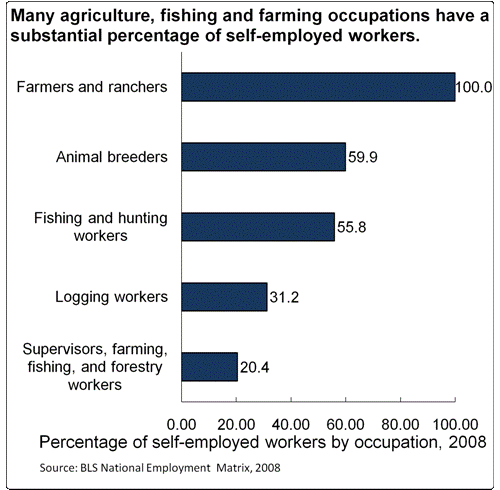
- Self-employed workers—mostly farmers and fishers—account for 39 percent of the industry's workforce.
- Employment in agriculture, forestry, and fishing is projected to have little or no change.
Top 3 Agriculture Jobs
-
Clinical Technology Specialist
- ForTec Medical
- Columbus,OH
Company Description ForTecMedical is an industry leader, dedicated to improving patient health. Our Mission is to improve patient health and healthcare by delivering innovative surgical technologies on demand. ForTec's commitment to excellence,...
-
Project Manager
- Hilscher Clarke Electric
- Columbus,OH
Join Hilscher-Clarke as a full-time Onsite Project Manager, based in the Columbus metro area, with the possibility of supporting projects outside the region as our footprint grows. At Hilscher-Clarke, we're more than a team – we're like a family.
-
Global Logistic Vice President
- Vertiv Holdings, LLC
- Westerville,OH
The role is responsible for the radical evolution of our global logistics footprint. This leader will inherit a fragmented, suboptimized legacy network and transform it into a high-velocity, scalable, and digitally-enabled engine.Your primary mission...
Nature of the Agriculture, Forestry, and Fishing Industries[About this section] [To Top]
The agriculture, forestry, and fishing industry sector plays a vital role in our economy and our lives. It supplies us and many other countries with a wide variety of food products and non-food products such as fibers, lumber, and nursery items. It contributes positively to our foreign trade balance and it remains one of the Nation's larger industries in terms of total employment. However, technology continues to enable us to produce more of these products with fewer workers, resulting in fewer farms and farmworkers.
Goods and services. Agriculture, forestry, and fishing includes two large subsectors—crop production and animal production—plus three smaller subsectors—forestry and logging, fishing, and agricultural support activities. Crop production includes farms that mainly grow crops used for food and fiber, while animal production includes farms and ranches that raise animals for sale or for animal products. The fishing subsector includes mainly fishers that catch fish and shellfish to sell, while the forestry and logging subsector includes establishments that grow, harvest, and sell timber. The agricultural support activities subsector includes establishments that perform any number of agricultural-related activities, such as soil preparation, planting, harvesting, or management on a contract or fee basis.
Establishments in agriculture, forestry, and fishing include farms, ranches, dairies, greenhouses, nurseries, orchards, and hatcheries. The operators, or people who run these agricultural businesses, typically either own the land in production or they lease the land from the owner. But production may also take place in the country's natural habitats and on government-owned lands and waterways, as in the case of logging, cattle-grazing, and fishing.
The vast majority of farms, ranches, and fishing companies are small enterprises, owned and operated by families as their primary or secondary source of income. Although large family farms (those generating more than $250,000 per year in gross annual sales) and corporate farms comprise less than 10 percent of the establishments in the industry, they produce three-fourths of all agricultural output. Increasingly, these large farms are being operated for the benefit of large agribusiness firms, which buy most of the product.
Industry organization. Agricultural production is the major activity of this industry sector and it consists of two large subsectors, animal production and crop production. Animal production includes establishments that raise livestock, such as beef cattle, poultry, sheep, and hogs; farms that employ animals to produce products, such as dairies, egg farms, and apiaries (bee farms that produce honey); and animal specialty farms, such as horse farms and aquaculture (fish farms). Crop production includes the growing of grains, such as wheat, corn, and barley; field crops, such as cotton and tobacco; vegetables and melons; fruits and nuts; and horticultural specialties, such as flowers and ornamental plants. Of course, many farms have both crops and livestock, such as those that grow their own animal feed, or have diverse enterprises.
The nature of agricultural work varies, depending on the crops grown, animals being raised, and the size of the farm. Although much of the work is now highly mechanized, large numbers of people still are needed to plant and harvest some crops on the larger farms. During the planting, growing, and harvesting seasons, farmers and their employees are busy for long hours, executing such activities as plowing, disking, harrowing, seeding, fertilizing, and harvesting. Vegetables generally are still harvested manually by groups of migrant farmworkers, although new machines have been developed to replace manual labor for some fruit crops. Vegetable growers on large farms of approximately 100 acres or more usually practice "monoculture," large-scale cultivation of one crop on each division of land. Fieldwork on large grain farms—consisting of hundreds, sometimes thousands, of acres—often is done using modern agricultural equipment, such as massive tractors controlled by global positioning system (GPS) technology.
Production of some types of crops and livestock tends to be concentrated in particular regions of the country based on growing conditions and topography. For example, the warm climates of Florida, California, Texas, and Arizona are well suited for citrus fruit production, while Northern States are better suited to growing blueberries, potatoes, and apples. Grains, hogs, and range-fed cattle are major products in the Plains States, where cattle feedlots also are numerous. In the Southwest and West, ranchers raise beef cattle.
Poultry and dairy farms tend to be found in most areas of the country. Most poultry and egg farms are large operations resembling production lines. Although free-range farms allow fowl some time outside during the day for exercise and sunlight, most poultry production involves mainly indoor work, with workers repeatedly performing a limited number of specific tasks. Because of increased mechanization, poultry growers can raise chickens by the thousands—sometimes by the hundreds of thousands—under one roof. Although eggs still are collected manually in some small-scale hatcheries, eggs tumble down onto conveyor belts in larger hatcheries. Machines then wash, sort, and pack the eggs into individual cartons. Workers place the cartons into boxes and stack the boxes onto pallets for shipment.
Aquaculture farmers raise fish and shellfish in salt, brackish, or fresh water, depending on the requirements of the particular species. Small fish farms usually use ponds, floating net pens, raceways, or recirculating systems, but larger fish farms are actually in the sea, relatively close to shore. Workers on aquaculture farms stock, feed, protect, and otherwise manage aquatic life to be sold for consumption or used for recreational fishing.
Horticulture farms raise ornamental plants, bulbs, shrubbery, sod, and flowers. Although much of the work takes place outdoors, in colder climates, substantial production also takes place in greenhouses or hothouses. The work can be year-round on such farms.
Workers employed in the forestry and logging subsector grow and harvest timber on a long production cycle of 10 years or more, and specialize in different stages of the production cycle. Those engaged in reforestation handle seedlings in specialized nurseries. Workers in timber production remove diseased or damaged trees from timberland, as well as brush and debris that could pose a fire hazard. Besides commercial timberland, they may also work in natural forests or other suitable areas of land that remain available for production over a long duration. Logging workers harvest timber, which becomes lumber for construction, wood products, or paper products. They cut down trees, remove their tops and branches, and cut their trunks into logs of specified length. They usually use a variety of specialized machinery to move logs to loading areas and load them on trucks for transport to papermills and sawmills.
People employed in the fishing subsector harvest fish and shellfish from their natural habitat in fresh water and in tidal areas and the ocean, and their livelihood depends on a naturally replenishing supply of fish, lobster, shellfish, or other edible marine life. Some full-time and many part-time fishers work on small boats in relatively shallow waters, often in sight of land. Crews are small—usually only one or two people collaborate on all aspects of the fishing operation. Others fish hundreds of miles offshore on large commercial fishing vessels. Navigation and communication are essential for the safety of all of those who work on the water, but particularly for those who work far from shore. Large boats, capable of hauling a catch of tens of thousands of pounds of fish, require a crew that includes a captain, or "skipper," a first mate and sometimes a second mate, a boatswain (called a deckboss on some smaller boats), and deckhands to operate the fishing gear, sort and load the catch when it is brought to the deck, and aid in the general operation of the vessel.
The final subsector of agriculture, forestry, and fishing includes companies that provide agricultural support services to establishments in the other subsectors. On farms that primarily grow crops, these activities may include farm management services, soil preparation, planting and cultivating services, as well as crop harvesting and post-harvesting services. Other support services companies provide aerial dusting and spraying of pesticides over a large number of acres. They may also perform post-harvesting tasks to prepare crops for market, including shelling, fumigating, cleaning, grading, grinding, and packaging agricultural products. Typically, such support services are provided to the larger farms that are run more like businesses. As farms get larger, it becomes more economical as well as necessary to hire specialists to perform a range of farm services, from pest management to animal breeding. Establishments providing farm management services manage farms on a contract or fee basis. As more farms are owned by absentee landowners and corporations, farm managers are being hired to run the farms. They make decisions about planting and harvesting, and they do most of the hiring of farmworkers and specialists.
The agricultural support services subsector also includes farm labor contractors who specialize in supplying labor for agricultural production. Farm labor contractors provide and manage temporary farm laborers—often migrant workers—who usually work during peak harvesting times. Contractors may place bids with farmers to harvest labor-intensive crops such as fruit, nuts, and vegetables or perform other short-term tasks. Once the bid is accepted, the contractor, or crew leader, organizes and supervises the laborers as they harvest, load, move, and store the crops.
Establishments that supply support activities for animal production perform services that may include breeding, pedigree record services, boarding horses, livestock spraying, and sheep dipping and shearing. Workers in establishments providing breeding services monitor herd condition and nutrition, evaluate the quality and quantity of forage, recommend adjustments to feeding when necessary, identify the best cattle or other livestock for breeding and calving, advise on livestock pedigrees, inseminate cattle artificially, and feed and care for sires.
Recent developments. The agriculture, forestry, and fishing industry sector is being transformed by the implementation of science and technology in almost every phase of the agricultural process. For example, bioengineered crops that are resistant to pests or frost or that can withstand drought conditions enable farmers to produce more food without using costly insecticides and irrigation. The use of GPS in tractors helps farmers to cut the time it takes to plant and harvest a crop and enables more rows of crops to be planted per acre. And the latest science in genetics is being used to breed animals with specific characteristics. The use of modern equipment and technology has changed the way ranching is done. Branding and vaccinating of herds, for example, are largely mechanized. The use of trucks, portable communications gear, and global positioning equipment now is common and saves valuable time for ranchers.
Marketing is becoming more important in agriculture. For small farms to make money, many have had to come up with ways to bypass the middleman and sell directly to consumers or other end users. For example, some fruit and vegetable growers use the marketing strategy of "pick-your-own" produce, set up roadside stands, or sell at farmers' markets. More local growers are contracting with nearby restaurants or grocery stores to sell their produce, many of which are being ordered over the Internet by customers.
Another development is the use of crops, particularly corn, to produce ethanol as a source of energy. The impact of this development on the agriculture industry is not yet known. The rise in the price of corn will no doubt help corn farmers, but may have unintended effects as land used for other crops is taken out of production and replaced with corn, and the rising price of corn causes problems for consumers of other corn products and producers that feed corn to animals. Organic farming, however, provides farmers with tremendous growth opportunities. The 2008 Farm Act, which provides farmers funding to convert their operations to organic agriculture, is expected to continue bolstering this segment. Its success is shown in the doubling of acreage devoted to it between 2002 and 2005, with more than 4 million acres of both pastureland and crops farmed organically. Sales of organically raised foodstuffs have grown four-fold since 1997, and the prospects for more such growth seem all but certain.
Work Environment for the Agriculture, Forestry, and Fishing Industries[About this section] [To Top]
Hours. While the working conditions in this industry sector vary by occupation and setting, there are some characteristics common to most agriculture, forestry, and fishing jobs. Work hours generally vary and the jobs often require longer than an 8-hour day and a 5-day, 40-hour week; work cannot be delayed when crops must be planted and harvested, or when animals must be sheltered and fed. Weekend work generally is the norm, and farmers, agricultural managers, crew leaders, farm-equipment operators, and agricultural workers may work a 6- or 7-day week during planting and harvesting seasons. Graders and sorters may work evenings or weekends because of the perishable nature of the products. Almost 22 percent of employees in this industry work variable schedules. Because much of the work is seasonal in nature, many farmworkers must cope with periods of unemployment or obtain short-term jobs in other industries when the farms have no work. Migrant farmworkers, who move from location to location to harvest crops as they ripen, live an unsettled lifestyle, which can be stressful.
Workers on farms that raise other products, particularly animals, have work that must be done all year long. On dairy farms, for example, the cows must be milked and fed every day and their stalls cleaned. Cows may then be taken outside for exercise and grazing. Dairy workers also may plant, harvest, and store crops, such as corn or hay, to feed the cattle through the cold of winter or the drought of summer.
Most workers employed in fishing return to their homes every evening. However, workers on vessels that range far from port may be at sea for days or even weeks. While newer vessels of this type have improved living quarters and amenities, such as television and shower stalls, crews still experience the aggravations of confined conditions, continuous close personal contact, and the absence of family.
Work environment. Agriculture, forestry, and fishing attract people who enjoy working with animals, living an independent lifestyle, or working outdoors on the land. For many, the wide-open physical expanse, the variability of day-to-day work, and the rural setting provide benefits that help to offset the sometimes hard labor and the risks associated with unseasonable or extreme weather and shifting outlook for revenues.
Much of the work on farms and ranches takes place outdoors, in all kinds of weather, and is physical in nature. Harvesting some types of vegetables, for example, requires manual labor and workers do a lot of bending, stooping, and lifting. Living conditions of contract laborers are guided by regulations to assure minimum standards. The year-round nature of much livestock production work means that ranch workers must be out in the heat of summer, as well as the cold of winter. Those who work directly with animals risk being bitten or kicked.
Farmers, farm managers, and agricultural workers in crop production risk exposure to pesticides and other potentially hazardous chemicals that are sprayed on crops or plants. To avoid injury, those who work on mechanized farms must take precautions when working with tools and heavy equipment.
Forestry and logging jobs are physically demanding and often dangerous, although machinery has eliminated some of the heavy labor. Most logging occupations involve lifting, climbing, clearing brush, felling trees, and other strenuous activities. Loggers work under unusually hazardous conditions. Falling trees and branches are a constant menace, as are the dangers associated with log-handling operations and the use of sawing equipment, especially delimbing devices. Special care must be taken during strong winds, which can halt operations. Slippery or muddy ground and hidden roots or vines not only reduce efficiency but also present a constant danger, especially in the presence of moving vehicles and machinery. Workers may encounter poisonous plants, brambles, insects, snakes, and heat and humidity. If safety precautions are not taken, the high noise level of sawing and skidding operations over long periods may impair hearing. If workers are to avoid injury, their experience, exercise of caution, and use of proper safety measures and equipment—such as hardhats, eye and ear protection, and safety clothing and boots—are extremely important.
Logging sites are often far from population centers and require long commutes. Some lumber companies set up bunkhouses or camps for employees to stay in overnight.
Fishing operations are conducted under various environmental conditions, depending on the region of the country, the kind of species sought, and the time of year. Storms, fog, and wind may hamper the work of fishing vessels. Those working in the fishing industry work under conditions that can quickly turn from pleasant to wet and hazardous, and help is often not readily available. Work must be performed on decks that are wet and slippery as the result of fish processing operations or ice formation in the winter. Workers must be constantly on guard against entanglement in fishing nets and gear, sudden breakage or malfunction of fishing gear, or being swept overboard. Malfunctioning navigation or communication equipment may lead to collisions with underwater hazards or other vessels and even shipwrecks. Also, when injuries occur, medical treatment beyond simple first aid usually is not available until the vessel can reach port.
Some component industries making up agriculture, forestry, and fishing have some of the highest incidences of illnesses and injuries of any industry. Those working with livestock had significantly higher incidences of work-related illness and injury than those working with crops.
Employment in the Agriculture, Forestry, and Fishing Industries[About this section] [To Top]
In 2008, agriculture, forestry, and fishing employed a total of 1.3 million wage and salary workers plus an additional 850,600 self-employed and unpaid family workers, making it one of the largest industries in the Nation. Over 86 percent of employment is in crop production and animal production. (See table 1.) Most establishments in agriculture, forestry, and fishing are very small. Nearly 78 percent employ fewer than 10 workers. Overall, this industry sector is also unusual in that self-employed and unpaid family workers account for such a high proportion of its workforce.
| Industry | Employment | Percent |
|---|---|---|
| Agriculture, forestry, and fishing, total | 2,098.3 | 100.0 |
| Crop production | 950.6 | 45.3 |
| Animal production | 860.6 | 41.0 |
| Support activities for agriculture and forestry | 141.3 | 6.7 |
| Logging | 82.0 | 3.9 |
| Fishing, hunting and trapping | 47.0 | 2.2 |
| Forestry | 16.8 | 0.8 |
Workers in agriculture, forestry, and fishing tend to be older than workers in other industries. In 2008, 30 percent of workers were 55 years or older, compared with 18 percent of all workers in all industries. In addition, self employed work is common in many agriculture, fishing, and forestry occupations (chart).
Occupations in the Agriculture, Forestry, and Fishing Industries[About this section] [To Top]
Agriculture is dominated by three large occupations—farmers and ranchers; farm, ranch, and other agricultural managers; and farmworkers. The industry sector also employs a number of other occupations that help support the industry.
Management and professional occupations. Farmers and ranchers are the self-employed owner-operators of establishments that produce agricultural output. They perform many tasks, both production-related and management-related. Along with planting, cultivating, and harvesting their crops, and feeding and raising their livestock, farmers and ranchers hire, train, and manage the schedules and supervise the work of farmworkers or farm labor contractors. They assign, monitor, and assess individuals' work. Farmers and ranchers also must perform the bookkeeping for their business and other activities. They keep records of their animals' health, crop rotation, operating expenses, major purchases, as well as pay bills and file taxes. If the farm or ranch has paid employees, its owner or operator may keep all of the paperwork needed to satisfy legal requirements, including payroll records and State and Federal tax records.
Farmers and ranchers must have additional skills to keep a farm or ranch operating. Computer literacy has become as necessary for farmers as it has for many other occupations. In addition, a basic understanding and working knowledge of mechanics, carpentry, plumbing, and electricity are helpful, if not essential, for running an agricultural establishment. Farmers who work large farms make decisions as much as a year in advance about which crop to grow. Therefore, a farmer must be aware of commodity prices in national and international markets to use for guidance, while tracking the costs associated with each particular crop. When dealing in hundreds or thousands of acres of one crop, even small errors in judgment are magnified, so the impact can be substantial. Thus, large-scale farmers strive to keep costs to a minimum in every phase of the operation. Furthermore, risk management of portfolios—the practice of juggling stocks, buying and selling futures, and engaging in other paper deals such as bond trading—is now becoming more important for owner-operators of large commercial farms.
Farm, ranch, and other agricultural managers operate farms, ranches, nurseries, timber tracts, and aquaculture operations on a daily basis for the owners. Agricultural managers perform many of the same tasks as do farmers and ranchers. Large commercial farms may have a manager for different operations within the establishment. On smaller farms, one manager may oversee all operations. Managers are responsible for purchasing machinery, seed, fertilizers, herbicides and pesticides, fuel, and labor. They must be aware of any laws that govern the use of such inputs in the farm's locality. Agricultural managers must be knowledgeable about crop rotation, soil testing, and various types of capital improvements necessary to maximize crop yields.
Foresters , a type of life scientist, manage forested lands for economic, recreational, and conservation purposes. They inventory the type, amount, and location of standing timber, determine the timber's worth, negotiate with purchasers for the timber, and draw up contracts for tree removal and procurement. Foresters determine how to conserve wildlife habitats and creekbeds, preserve water quality and soil stability, and comply with environmental regulations. They also devise plans for planting and growing trees, monitor the trees' growth, and determine the best time for harvesting.
Farming, fishing, and forestry occupations. Agricultural workers include occupations that perform a whole spectrum of daily chores involved in crop and livestock production. Graders and sorters ensure the quality of the agricultural commodities that reach the market. They grade, sort, or classify unprocessed food and other agricultural products by size, weight, color, or condition. Farmworkers and laborers, crop, nursery, and greenhouse manually plant, maintain, and harvest food crops; apply pesticides, herbicides, and fertilizer to crops; and cultivate plants used to beautify landscapes. They prepare nursery acreage or greenhouse beds for planting; water, weed, and spray trees, shrubs, and plants; cut, roll, and stack sod; stake trees; tie, wrap, and pack flowers, plants, shrubs, and trees to fill orders; and dig up or move field-grown and containerized shrubs and trees. Additional duties include planting seedlings, transplanting saplings, and watering and trimming plants.
Farmworkers (farm and ranch animals) care for farm, ranch, or aquaculture animals that may include cattle, sheep, swine, goats, horses, poultry, finfish, shellfish, and bees. They also tend to animals raised for animal products, such as meat, fur, skins, wool, feathers, eggs, milk, and honey. Duties may include feeding, watering, herding, grazing, castrating, branding, debeaking, weighing, catching, and loading animals. These farmworkers also may maintain records on animals, examine animals to detect diseases and injuries, assist in birth deliveries, and administer medications, vaccinations, or insecticides, as appropriate. Daily duties include cleaning and maintaining animal housing areas. These workers also may repair farm buildings and fences and haul livestock products to market. On dairy farms, they may operate milking machines and other dairy-processing equipment. Animal breeders select and breed animals according to their genealogy, characteristics, and offspring. Usually, these workers need knowledge of the techniques of artificial insemination. Often, they keep the records of these animals' birth cycles and pedigree.
Forest and conservation workers perform a variety of tasks to reforest and conserve timberlands and maintain forest facilities, such as roads and campsites. They may plant tree seedlings to reforest timberland areas, remove diseased or undesirable trees, and spray trees with insecticides. They also may clear away brush and debris from trails, roadsides, and camping areas. Other forest and conservation workers work in forest nurseries, sorting out tree seedlings and discarding those that do not meet prescribed standards of root formation, stem development, and foliage condition.
Fishers and related fishing workers use nets, fishing rods, or other equipment to catch and trap various types of marine life for human consumption, animal feed, bait, and other uses. Fishing boat captains plan and oversee fishing operations—the fish to be sought, the location of the best fishing grounds, the method of capture, the duration of the trip, and the sale of the catch. First mates are captains' assistants who assume control of the vessel when the captain is off duty. They also must be familiar with navigation requirements and the operation of the vessel and all of its electronic equipment. Boatswains, highly experienced deckhands with supervisory responsibilities, direct the deckhands as they carry out the sailing and fishing operations.
Training and Advancement in the Agriculture, Forestry, and Fishing Industries[About this section] [To Top]
Most jobs in agriculture, forestry, and fishing are learned on the job. The industry sector employs a large number of workers with relatively lower levels of educational attainment. Approximately 28 percent of this sector's workforce does not have a high school diploma. However, farmers, ranchers, and agricultural managers who seek to make a living from their work, are increasingly getting college degrees to learn how to run a business and how to take advantage of new agricultural technologies.
Management, business, and financial occupations. Becoming a farmer generally does not require formal training or credentials. However, knowledge of and expertise in agricultural production are essential to success for prospective farmers. Traditionally, a farmer picked up this knowledge by growing up on farm, but this background is becoming less common as most modern day farmers are more likely to have purchased their farm than to have inherited it. But even with a farming background, a person considering farming would benefit from a formal postsecondary agricultural education offered by either community colleges or land-grant colleges and universities, found in all States and territories. Programs usually incorporate hands-on training to complement the academic subjects. Typical coursework covers the agricultural sciences (crop, dairy, and animal) and business subjects such as accounting, marketing, and farm management. Also, some private organizations help people gain farming skills, particularly if they are interested in more "alternative" types of farming.
Experience and some formal education are necessary for agricultural managers. A bachelor's degree in business with a concentration in agriculture provides a good background, and work experience in the various aspects of farm or ranch operations enhances knowledge and develops decision-making skills. The experience of having performed tasks on other farming establishments as a farmworker may save managers valuable time in forming daily or monthly work plans and help them to avoid pitfalls that could result in financial burdens for the farm.
Whether it is gained through experience or formal education, both farmers and agricultural managers need enough technical knowledge of crops, growing conditions, and plant diseases to make sound scientific and business decisions. A rudimentary knowledge of veterinary science, as well as animal husbandry, is important for dairy and livestock farmers, ranchers, and agricultural managers.
It also is crucial for farmers, ranchers, and agricultural managers to stay abreast of the latest developments in agricultural production. They may do this by reviewing agricultural journals that publish information about new cost-cutting procedures, new forms of marketing, or improved production using new techniques. County cooperative extension agencies serve as a link between university and government research programs on the one hand, and farmers and farm managers on the other, providing the latest information on numerous agriculture-related subjects. County cooperative extension agents may demonstrate new animal-breeding techniques or more environmentally safe methods of fertilizing, for example. Other organizations provide information—through journals, newsletters, and the Internet—on agricultural research and the results of implementing innovative methods and ideas.
Farming, fishing, and forestry occupations. Training and education requirements for general farmworkers are few. Some experience in farmwork or ranchwork is beneficial, but most tasks can be learned fairly quickly on the job. Advancement for farmworkers is somewhat limited, although motivated and experienced farmworkers may become crew leaders or farm-labor contractors. Also, firsthand knowledge of farm produce is good preparation for grading, sorting, and inspecting, so some farmworkers become agricultural graders and sorters or inspectors. Farmworkers who wish to become independent farmers or ranchers first must buy or lease a plot of land, which can be a substantial financial commitment if one buys instead of leases.
Some private organizations are helping to make farmland available and affordable for new farmers through a variety of institutional innovations. Land Link programs, coordinated by the National Farm Transition Network, operate in 20 States. They help match up young farmers with farmers approaching retirement so that arrangements can be made to pass along their land to young farmers wishing to keep the land under cultivation. Often beginning farmers lease some or all of their farmland. Sometimes, a new farmer will work on a farm for a few years, while the farm owner gradually transfers ownership to the new farmer.
Most forest, conservation, and logging workers develop skills and learn to operate the complex machinery through on-the-job training, with instruction coming primarily from experienced workers and logging companies' training. Some trade associations also offer special training programs. Safety training is a vital part of instruction for all logging workers.
Many State forestry and logging associations provide training sessions for fallers, whose jobs require more skill and experience than other positions on the logging team. Sessions may take place in the field, where trainees, under the supervision of an experienced logger, have the opportunity to practice various felling techniques. Fallers learn how to manually cut down extremely large or expensive trees safely and with minimal damage to the felled or surrounding trees. They also may receive training in best management practices, safety, endangered species preservation, reforestation, and business management. Some programs lead to logger certification.
Workers in the fishing industry subsector usually acquire occupational skills on the job, many as members of families involved in fishing activities. No formal academic requirements exist. Operators of large commercial fishing vessels are required to complete a Coast Guard-approved training course. Students can expedite their entrance into fishing occupations by enrolling in 2-year vocational-technical programs offered by secondary schools. In addition, some community colleges and universities offer fishery technology and related programs that include courses in seamanship, vessel operations, marine safety, navigation, vessel repair and maintenance, health emergencies, and fishing gear technology. Courses include hands-on experience. Secondary and postsecondary programs are normally offered in or near coastal areas.
Fishers must be in good health and possess physical strength. Good coordination, mechanical aptitude, and the ability to work under difficult or dangerous conditions are necessary to operate, maintain, and repair equipment and fishing gear. On large vessels, they must be able to work as members of a team. Fishers must be patient, yet always alert, and must be able to deal with the boredom of long watches when their vessel is not engaged in fishing operations. The ability to assume any deckhand's functions, on short notice, is important. As supervisors, mates must be able to assume all duties, including the captain's, when necessary. The captain must be highly experienced, mature, and decisive, and must possess the business skills needed to run business operations.
On fishing vessels, most workers begin as deckhands. Deckhands who acquire experience and whose interests are in ship engineering—maintenance and repair of ship engines and equipment—can eventually become licensed chief engineers on large commercial vessels, after meeting the Coast Guard's experience, physical, and academic requirements. Experienced, reliable deckhands who display supervisory qualities may become boatswains. Boatswains may become second mates, first mates, and, finally, captains. Almost all captains become self-employed, and the overwhelming majority eventually own, or have an interest in, one or more fishing vessels. Some may choose to run a sport or recreational fishing operation. When their seagoing days are over, experienced individuals may work in or, with the necessary capital, own stores selling fishing and marine equipment and supplies.
Job Outlook for the Agriculture, Forestry, and Fishing Industries[About this section] [To Top]
The agriculture, forestry, and fishing industry sector is expected to continue to produce more through the use of increasingly productive machinery and increased use of science. Despite technological advances and greater automation, overall employment in agriculture, forestry, and fishing is expected to show little or no change.
Employment change. Employment in the agriculture, forestry, and fishing industry sector is projected to experience little or no change over the 2008-2018 period, which is a contrast to many years of employment declines. Rising costs, greater productivity, increasing urbanization, and greater imports of lumber and fish will cause many workers to leave this industry, although at a slower pace than in the past.
Market pressures on the family farm will continue to drive consolidation in the industry, as the more prosperous farms become bigger so as to achieve greater economies of scale, along with a greater portion of farm subsidies. In addition, increasing productivity overall means that it takes less farm labor to produce crops and livestock than in the past. For many farmers, the low prices for many agricultural goods have not kept up with the increasing costs of farming. For those who need to make a living from their farm, these conditions make it difficult for many small farmers to survive.
Employment declines in agriculture, forestry, and fishing, however, are being moderated by other changes taking place in agriculture. For instance, domestic consumers are increasingly gravitating toward purchasing their agricultural products from farmers markets, community supported agriculture, and other locally grown food producers. Exports for agricultural products also are rising, reflecting international demand. New developments in the marketing of milk and other agricultural produce through farmer-owned and -operated cooperatives hold promise for some dairy and other farms. Furthermore, demand continues to rise for organic farm produce—grown to a great extent on small- to medium-sized farms. The production of crops without the use of pesticides and certain chemicals is allowing farms of small acreage to remain economically viable. Also, some Federal, State, and local government programs provide assistance targeted at small farms. For example, some programs allow farmers to sell the development rights to their property to nonprofit organizations devoted to preserving green space. This immediately lowers the market value of the land—and the property taxes levied on it—making farming more affordable.
Employment in aquaculture had been growing steadily in recent years in response to growth in the demand for fish. However, competition from imported farm-raised fish and unsettled regulatory concerns about environmental impacts of fish farms is slowing the growth of aquaculture.
In fishing, increases in imports and efforts to revive many fisheries through stringent limits on fishing activity will continue to lead to employment declines. In certain areas of the country, such as Alaska, prudent management has sustained healthy fisheries that should continue to harvest massive amounts of fish. In other areas, fisheries have been damaged by coastal pollution and depleted by years of overfishing. In these areas there will be fewer jobs for fishers.
The logging subsector should experience more favorable employment prospects for the first time in many years. Though domestic timber producers continue to face competition from foreign producers who can harvest the same amount of timber at lower cost, foreign and domestic demand for new wood products, such as wood pellets, is expected to result in some employment growth. New policies allowing some access to Federal timberland may result in some logging jobs, and Federal legislation designed to prevent destructive wildfires by proactively thinning forests in susceptible regions also may result in additional jobs.
The forestry subsector is also projected to show an increase in wage and salary workers as owners of forested lands are expected to hire people to plant and raise timber stands. However, professionals in the forestry industry will likely turn to self-employment as consultants.
Job prospects. Jobs in agriculture and fishing are expected to remain hard to find and vulnerable to being eliminated. Employment on many farms will continue to be characterized by low wages and lack of benefits. While employment of self-employed farmers and ranchers is projected to decrease slightly, employment of farm, ranch, and other agricultural managers is expected to remain stable. Thus, as more farms are owned by either corporations or absentee owners, these agricultural managers will play a relatively larger role in the operation of farms. In contrast, the numbers of farmworkers in crops, nurseries, and greenhouses are expected to decline as technology continues to replace manual labor and as fewer workers seek jobs in this field. Opportunities in organic farming are expected to be better.
In forestry, those seeking employment may expect some competition as owners of forest lands decide to use the land for other purposes, mainly recreational. Those with degrees in forestry will fare best, as they should be able to find work with consulting firms or in State or local government. Employment in logging is expected to be more favorable as new Federal policies to thin forests and allow access to Federal land should result in some jobs. The best job opportunities will be for those workers with more skills, such as technicians, operators, and mechanics.
Agriculture, Forestry, and Fishing Salaries[About this section] [More salary/earnings info] [To Top]
Industry earnings. In 2008, median earnings for all workers in the agriculture, forestry, and fishing industry sector were $459 a week, with a wide range from less than $301 a week for the lowest 10 percent to more than $1,009 a week for the highest 10 percent. Lower than average earnings are due in part to the low skill level required for many of the jobs in the industry and to the seasonal nature of the work.
Farm income can vary substantially depending on a number of factors, including the type of crop or livestock being raised, price fluctuations for various agricultural products, and weather conditions that affect yield. In some cases, government subsidies may supplement a farmer's income. For a growing number of farmers and ranchers, particularly those working on farms for residential and lifestyle reasons, crop or livestock production is not their major occupation or source of income.
Benefits and union membership. Benefits in agriculture, forestry, and fishing are known to be generally much lower than those in manufacturing industries or high-tech industries. Those who are self-employed, particularly farmers, fishers, and agricultural managers, must provide for their own health insurance and plan for their own retirements above and beyond Social Security. Few workers in agriculture, forestry, and fishing are represented by unions.
*Some content used by permission of the Bureau of Labor Statistics, U.S. Department of Labor.